

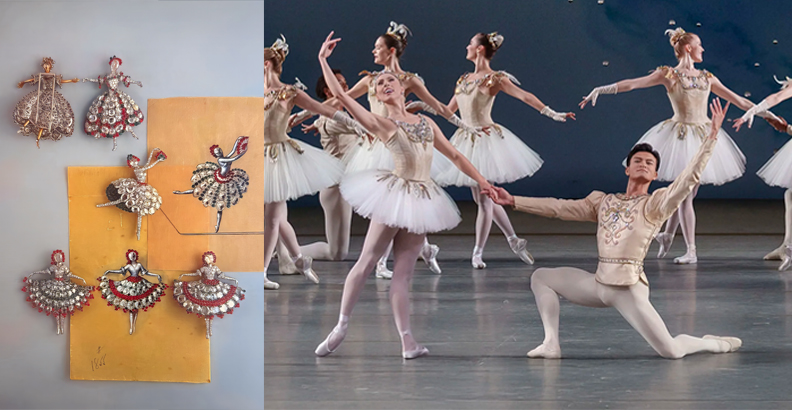
Editor’s Note: Writing about Nevada Ballet Theatre’s exciting 55th season meant spending a lot of time with George Balanchine, whose choreography turns up in three of its five programs. So, when Marion Fasel’s recent article on the backstory of Balanchine’s Jewels landed in my Inbox, I found it precisely on point (or en pointe, as the case may be).
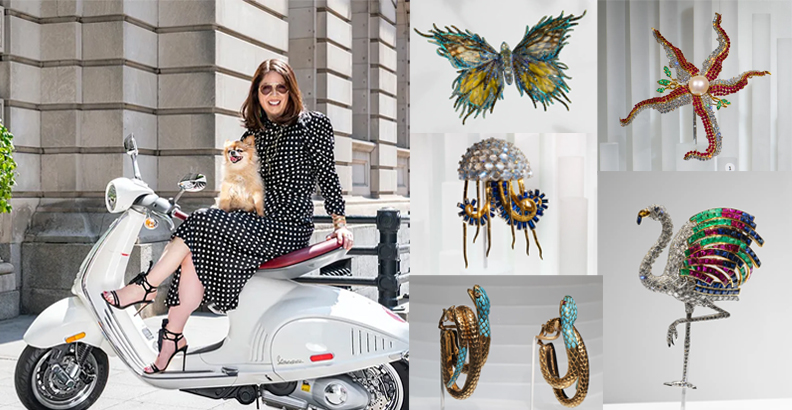
Marion is an acclaimed jewelry historian with 11 books to her name—the first five with the late Penny Proddow, including Hollywood Jewels: Movies, Jewelry, Stars, which landed the pair at InStyle as Contributing Editors of Fine Jewelry & Watches—and she has since authored Assouline’s Bvlgari trilogy (Serpenti, Monete, and Bvlgari-Bvlgari) and The History of Diamond Engagement Rings: A True Romance. Additionally, she guest-curated Beautiful Creatures: Jewelry Inspired by the Animal Kingdom, the first jewelry exhibition in the renovated Mignone Halls of Gems and Minerals at the American Museum of Natural History.
Launching her newsletter in 2015 as an online fine jewelry magazine, Marion named it The Adventurine, taking the name from the gemstone aventurine and adding a ‘d,’ because she feels jewelry stories should take you on a journey. Since 2025, The Adventurine—often cited by The New York Times—has lived on Substack.
So, enjoy Marion's deep dive into George Balanchine’s Jewels and the famed choreographer’s relationship with the storied French Maison, Van Cleef & Arpels [accompanied by my captions]. And if you like it, subscribe to The Adventurine!
There Is More to the Story of Balanchine’s Jewels
On Tuesday night, the New York City Ballet season opened with George Balanchine’s Jewels. I have lost count of how many times I have seen the masterwork that debuted in 1967. It’s circulated in and out of the repertoire. Not that anyone is asking, but I think it should be performed annually like Balanchine’s rendition of The Nutcracker.
Jewels runs about two hours, has three acts—“Emeralds,” “Rubies,” and “Diamonds”—two intermissions, and zero dips in the excitement. The plotless production flows, erupts, and emotes from beginning to end.
The glamour of it all sends my mind reeling back to a time in history when the term “culture” wasn’t tossed around as a marketing buzzword, but meant something substantial. And Balanchine was at the pinnacle of New York culture. His work was revered by many, but perhaps none more so than super fan Edward Gorey, who attended all his performances. When the choreographer died in 1983, it was such a blow to the artist that he considered moving out of New York City.
Over the years, when Jewels is performed, I’ve noticed the media coverage has become so simplified that it is now something like this: George Balanchine visited Van Cleef & Arpels and came up with the idea for the ballet.
But there's much more to it, and the timeline actually stretches back to 1939. Prominent figures from the worlds of classical music, ballet, and jewelry make up the cast.
Bringing together facts from all sides of the story, along with historic photographs and jewels, shows that George Balanchine had a relationship with several Van Cleef & Arpels principals. It’s a far more compelling narrative than has been told.
When did George Balanchine meet Claude Arpels?
According to the New York City Ballet, George Balanchine met Claude Arpels of Van Cleef & Arpels in 1939. The 35-year-old choreographer was introduced to the jeweler by his friend Nathan Milstein, a fellow Russian émigré and one of the world's greatest violinists.
While the NYC Ballet does a grand jeté forward 30 years in their story to when the ballet was believed to have been conceived, the 1939 date makes this jewelry historian want to take a loupe to the situation and put it in context.
The year marks when the 28-year-old Claude Arpels, part of the second generation of the family to run the firm, spearheaded the American operations and moved to Manhattan to participate in the 1939 World’s Fair.
He also opened an office in the Maison Française building at 610 Fifth Avenue in Rockefeller Center. So it made sense that locally based friends of the young jeweler, like Mr. Milstein, hosted introductory dinners.
When Claude Arpels opened the Van Cleef & Arpels boutique at 744 Fifth Avenue in 1940, the jeweler’s distinctively French, romantic, classical, and highly fashionable collections became more readily available to well-heeled New Yorkers. My favorite way to illustrate Van Cleef’s style compared to other jewelers at their level is to look at how they interpreted Art Deco.
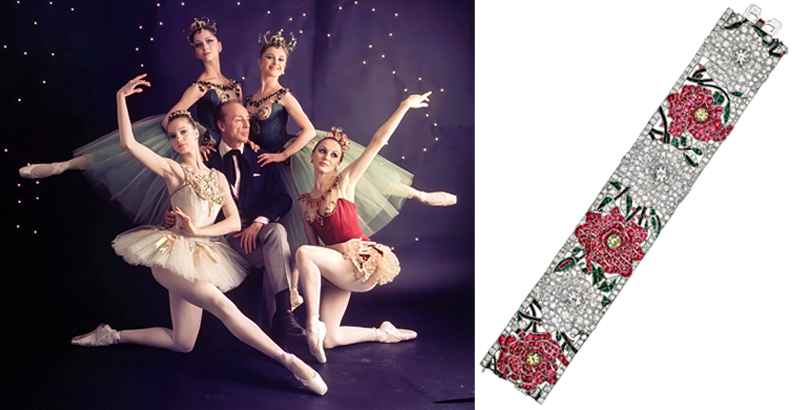
Among the displays of geometric jewelry at the 1925 Exposition des Arts Décoratifs et Industriels Modernes in Paris, Van Cleef & Arpels showed elegant jewels with rose motifs, including the ‘Entwined Roses’ bracelet, pictured in the slideshow above. The work won the Maison a Grand Prize at the Exposition.
Balanchine’s approach to ballet is analogous. Experts describe his choreography as “neoclassical,” meaning he used traditional ballet technique and music, but presented it in a modern way. Sometimes this meant simplifying elements such as sets or costumes. Eventually, Balanchine created Jewels, considered the first three-act plotless ballet.
What inspired the Van Cleef & Arpels ballerina brooches?
Louis Arpels, one of the founders of Van Cleef & Arpels and a ballet enthusiast, is credited with the idea for the ballerina brooches, which have become a symbol of the House and one of the most well-known collections in 20th-century jewelry.
In 1930s Paris, Louis, described as having “the same type of jaunty charm as Maurice Chevalier,” often went to the ballet at the Opéra Garnier. Occasionally, he took his nephew, Claude.
A dashing figure among society, the married jeweler had an, um, interest in the ballet that extended to an affair with British prima ballerina Alicia Markova. The romance became a favorite subject of the Hearst syndicated gossip columnist “Cholly Knickerbocker.”
Of Jewish descent, “Monsieur Louis” and his fashion-model wife, Hélène, fled Paris shortly after the Nazi Occupation began. In August 1940, they boarded one of the last wartime liners bound for the United States. After arriving in New York, Louis helped Claude establish the boutique. It has also been reported that Louis met George Balanchine at some point, although the exact timing is unclear.
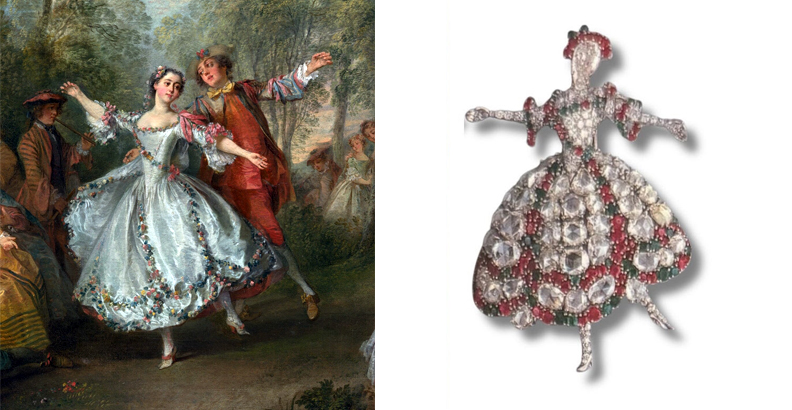
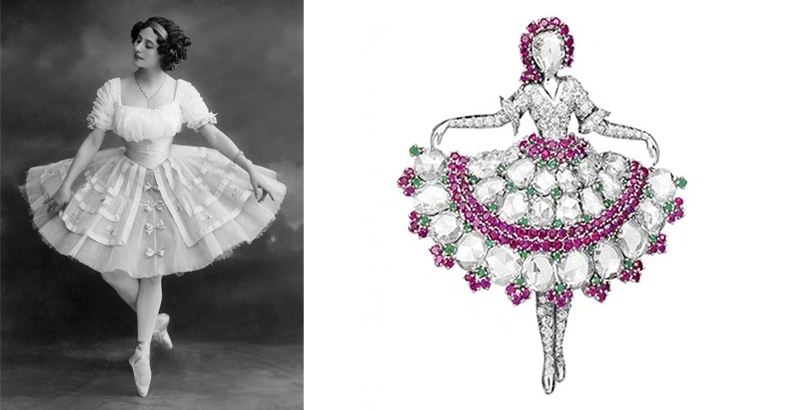
The first of the Van Cleef & Arpels ballerina brooches debuted in New York in 1941. Among the troupe were marquee names from the history of ballet. Eighteenth-century sensation Maria Camargo danced in several brooches. And so did early-20th-century Russian star Anna Pavlova.
The exceptional French designer and draftsman Maurice Duvalet created the jewel renderings, based on imagery of the dancers, after emigrating to the United States after World War I and working for other esteemed jewelers before joining Van Cleef & Arpels and its French manufacturer, John Rubel. (The company anglicized its first name from Jean to John when it relocated to New York.)
Antique rose-cut diamonds were the defining feature of the first several ballerina brooches, giving the pieces their distinctive chunkiness. As a tribute to the originals, Van Cleef & Arpels uses a rose-cut gem for the heads of their ballerinas to this day.
The Ballerina brooch depicting Balanchine’s wife
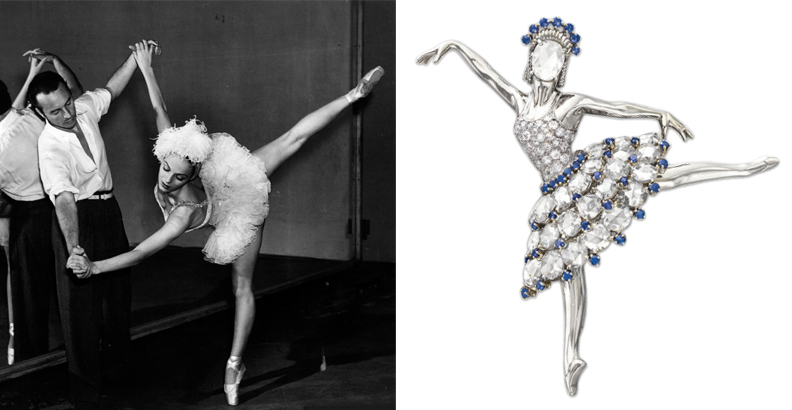
The most significant physical piece of evidence of Balanchine’s ongoing relationship with Van Cleef & Arpels is the brooch made around 1944 depicting his wife, the German-Norwegian ballerina Vera Zorina. She is the only contemporary dancer known to be part of the original series.
In terms of the diamond and metalwork, the piece is distinctive from the Camargo and Pavlova styles of the period. The Zorina brooch, drawn by Duvalet, looks modern, with sleek, unadorned platinum arms, torso, and legs. The diamond-and-sapphire combination is also singular.
It’s possible Balanchine requested these details. He is known to like sapphires and wanted to include the gem in the Jewels ballet, but decided against it because the color didn’t translate on stage.
It’s also possible the jewel was a gift from Van Cleef & Arpels to the choreographer and his wife, as a gesture of friendship or perhaps even in gratitude for input on the series of ballerina jewels.
Balanchine and Zorina were a famous and successful couple in the 1940s. The idea for what would become the New York City Ballet was in the early stages. Balanchine choreographed Hollywood movies and Broadway productions. And Zorina was a star of stage and screen. She danced in Louisiana Purchase (1941), with choreography by Balanchine.
Yet, if I had to decide between a gift from Van Cleef or a purchase by Balanchine, I’d choose the gift camp. The ballerina brooches have always been an extravagance. Some of the originals were owned by the richest women in the world, including Barbara Hutton, Marjorie Merriweather Post, and Jessie Woolworth Donahue. Today, Britain’s Queen Camilla has contemporary renditions, and uber-wealthy Indian businesswoman Isha Ambani has acquired one of the original Pavlovas.
The debut of Jewels in 1967
Balanchine was notorious for refusing to explain his ballets. He believed the work should speak for itself. But he did enjoy staging photo ops that were kind of publicity stunts for the press.
Given his preference to remain silent about his work, it is remarkable that Balanchine acknowledged Van Cleef & Arpels as a source of inspiration at least once. While the jeweler has never explicitly stated the details of a relationship, and they may be lost, it seems highly likely that members of the Arpels family at the very least financially supported the choreographer as early as the 1940s.
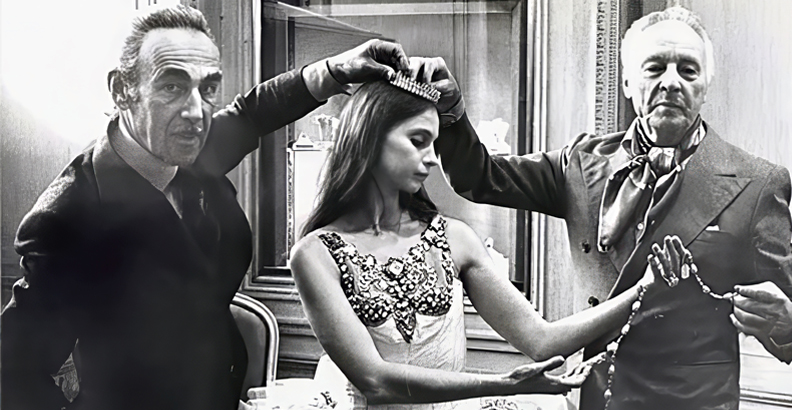
One detail that seems to have been confused is the debut press conference for Jewels at Van Cleef & Arpels. Many, including yours truly, have written that this happened in New York in 1967 based on the picture with Pierre Arpels in the slideshow above. Even Jennifer Homans, the author of the 800-page biography Mr. B: George Balanchine’s 20th Century, states, “…Balanchine took Farrell to the Arpels showroom for a publicity shoot.” But no outstanding images of the moment survive.
The photograph in the slideshow of Pierre Arpels and Balanchine flanking Suzanne Farrell was taken in 1976 at the Van Cleef & Arpels boutique on Place Vendôme in Paris to drum up press for the debut of Jewels in the City of Light. Seeing it alongside the other photos in the slideshow shows how he'd aged and changed his signature look between 1967 and 1976; though, if nothing else, the picture at the boutique in Paris proves his ongoing relationship with the Arpels family.
When Jewels debuted, it received raves, but it had no name. The New York Times critic Clive Barnes said as much in his review:
Curiously enough, I have never felt any particular emotions about jewels; colored glass suits me almost as well. Yet George Balanchine’s new three-act ballet, “The Jewels,” (it still has no title on the program, but it has to be called something) delights me. Although its acts are called Emeralds, Rubies and Diamonds and Karinska has decked out her costumes in appropriately colored glass, the ballet has nothing at all to do with precious gems or, indeed, with anything else. It is simply a ballet about music and dancing. And what dancing it is!
I have to agree to disagree with the legendary Mr. Barnes. I think the ballet is Balanchine’s expression of a shared elegance between the two mediums. I believe the choreographer appreciated the art of jewelry and the beauty of gems long before he conceived his masterpiece.
The Adventurine
Marion Fasel
Get into it!
#TheAdventurine
 |
 |
 |
 |
 |
 Website Powered by BannerOS. Your Business Energized!