


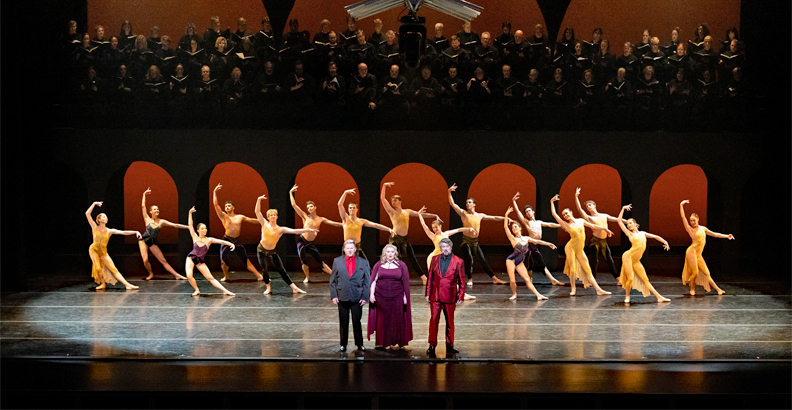
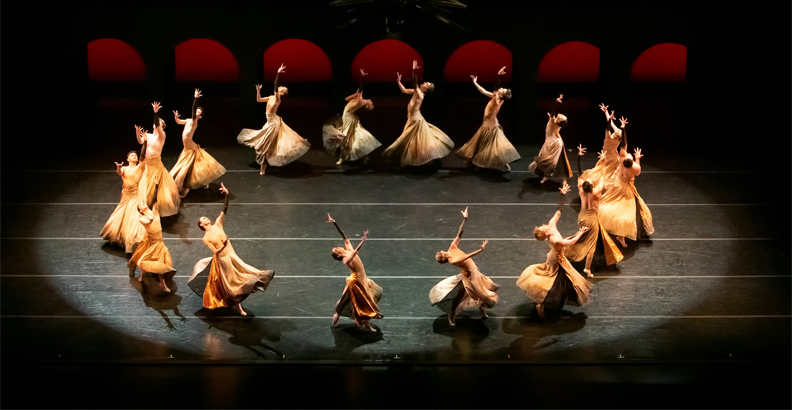
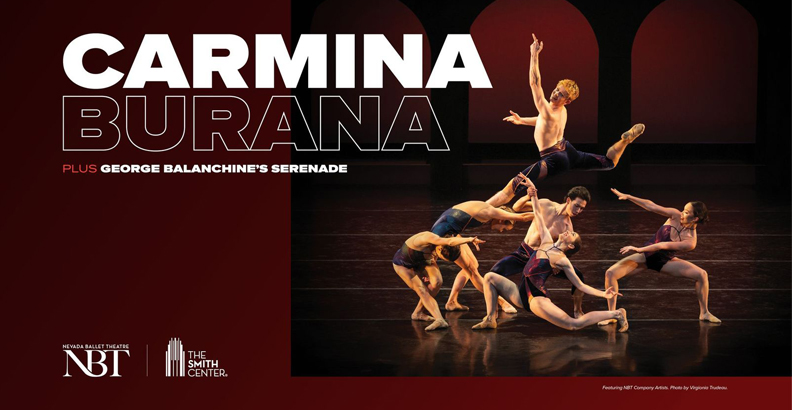
On October 02, Nevada Ballet Theatre will kick off its 2026–27 lineup by returning to The Smith Center for the Performing Arts with a full orchestra, a choir, and Carl Orff’s Carmina Burana, the first of five programs that encompass the venerable organization’s 55th season.
You know “O Fortuna,” even if you don’t know that you know it. It has opened The X Factor, been sampled by Nas, and been spoofed by Applebee’s; been used in commercials for Gatorade, T-Mobile, and Hershey’s, and in a Super Bowl campaign for Domino’s Pizza; not to mention on the login screen for World of Warcraft, and on such television series as How I Met Your Mother, The Simpsons, American Dad!, Brooklyn Nine-Nine, and Glee (where it was designated as the personal theme music for nefarious cheerleading coach Sue Sylvester, the iconic role for which actress Jane Lynch would win an Emmy, a Golden Globe, and a SAG Award). However, contrary to popular belief, it was not the theme from The Omen (which was Jerry Goldsmith’s Academy Award-nominated “Ave Satani”). Well, “O Fortuna” both opens and closes Orff’s Carmina Burana, 24 medieval poems he set to music in 1935–36 from a manuscript found in 1803 at the Bavarian monastery of Benediktbeuern, hence the name, which is Latin for “Songs from Benediktbeuern.” Nicolo Fonte created his ballet for Ballet West in 2017, and this third NBT staging in six seasons will again feature the Las Vegas Philharmonic and the Las Vegas Master Singers.
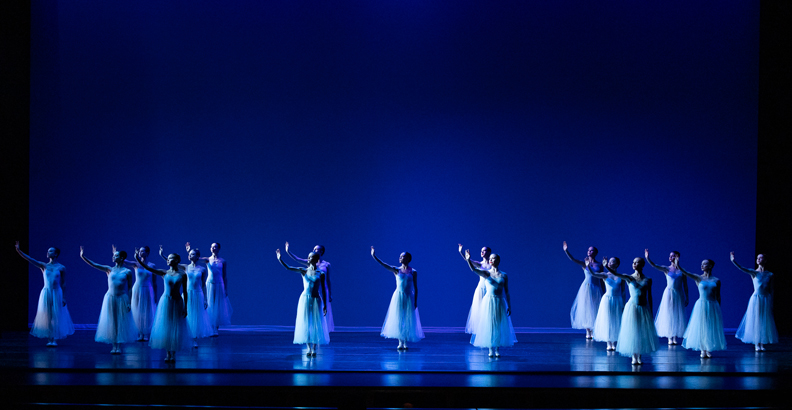
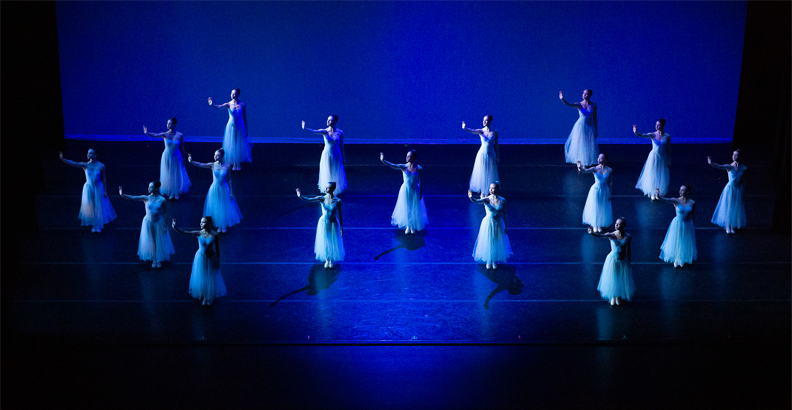
Sharing the bill is George Balanchine’s Serenade, set to Tchaikovsky’s 1880 composition Serenade for Strings in C Major, Op. 48, and the first ballet Balanchine made in America. He made it to teach the students of his new School of American Ballet, who first danced it at Felix M. Warburg’s Westchester County estate, Woodlands, in June 1934, prior to the production’s official premiere at New York’s Adelphi Theater the following year. Seventeen women came to the first rehearsal, nine to the next, and then six, so Balanchine choreographed each scene with however many dancers he had on hand, even incorporating a student’s fall and a late arrival! He also swapped Tchaikovsky’s last two movements, so the ballet ends with the grand, emotionally sweeping “Elegy” movement. In 2012, after noticing a system of bright, diffuse blue rays emanating from an impact crater on Mercury, geophysicist and planetary scientist Brett Denevi—who later explained to Space.com, “I’ve done ballet my whole life, I’m a huge fan of dance”—was reminded of Serenade’s long, flowy blue tutus, and so, as she put it, “I named it Balanchine.”
December marks the return of George Balanchine’s The Nutcracker®. The story originated in 1816 as The Nutcracker and the Mouse King by E.T.A. Hoffmann, and in 1844 Alexandre Dumas adapted it as The Tale of a Nutcracker, before Tchaikovsky premiered his ballet version at St. Petersburg’s Mariinsky Theatre in 1892, on a double bill with his opera Iolanta. It flopped, and Tchaikovsky himself had already declared the ballet “infinitely worse than Sleeping Beauty.” Regrettably, he didn’t live to see it become the most frequently performed ballet of all time. Balanchine himself danced the role of the Prince in Russia at age 15 and premiered his own version at New York City Ballet in 1954—where it has been performed every year since, except for 2020—giving the roles of Marie and the Prince to children. NBT introduced Balanchine’s Nutcracker into its repertoire last season, and will perform it 16 times this season, from December 12–27, with the LV Philharmonic providing live music for the first three shows.
February’s Balanchine & Kylián is a program for connoisseurs. First is Concerto Barocco, which began in 1941 as a classroom exercise for Balanchine’s advanced students and was on the bill at New York City Ballet’s very first performance, in 1948. It’s set to Bach’s Concerto in D minor for Two Violins, but don’t let the Bach fool you: “Make it jazzy,” Balanchine told his dancers. “Lead with the hip.” Next is Duo Concertant, written by Stravinsky for the violinist Samuel Dushkin in 1931–32. Four decades later, Balanchine set it for New York City Ballet’s Stravinsky Festival; it opens with its two dancers doing nothing but listening to the musicians onstage and ends in a single pool of light. Rounding out the program is the Las Vegas premiere of Jiří Kylián’s Sechs Tänze (Six Dances), the first Kylián work NBT’s dancers have ever performed, comprising 13 bewigged, funny minutes set to Mozart. Kylián made it in 1986 for Nederlands Dans Theater, the company he led from 1976 and for which, in 1992, he started a troupe featuring only dancers over 40.
In April, Septime Webre’s Alice (in Wonderland) is back. The book by Lewis Carroll—which originated as a story he told the three young daughters of Henry Liddell on July 04, 1862, while rowing up the Isis from Oxford—came out in 1865 and has never been out of print. Webre, who drew on both it and Through the Looking-Glass, premiered his ballet at The Washington Ballet in 2012, adding a prologue in which Alice’s family turns up in Wonderland: her overbearing mother as the Queen of Hearts, her sisters as Tweedledee and Tweedledum, and Carroll himself as the Mad Hatter. Matthew Pierce’s score gives each character its own sound effects, and Liz Vandal, who has designed for Cirque du Soleil, drew on Mick Jagger, David Bowie, Elton John, and Starsky and Hutch (!) for the roughly 130 costumes, many of which are cut in the Victorian style and feature chaotic prints. Ballet, modern, and hip hop are all in full force here, and the characters literally take flight. “Ballerinas and Jabberwockies should never hit the wings on their exit,” Webre has said, and back in 2019, when NBT gave the ballet its Las Vegas premiere, the Jabberwocky was a 25-foot puppet worked by seven dancers. This time around, 60 students from the School of Nevada Ballet join the company for six performances, April 09–18.
The season closes May 05–08 with Dance Lab, for which choreographers—chosen from applicants from around the world—create new works for NBT’s dancers, set to music by young composers working in conjunction with the UNLV School of Music. It might well be the closest you’ll get to observing the genesis of a ballet.
You can see all five programs with a full-season subscription from as little as $299. And for those of you suffering from PTND (post-traumatic Nutcracker disorder), resulting from years of watching Sugar Plum Fairies, German godfathers, and dancing mice, the Flex package, with seats for the season (sans Nutcracker) starting at $269, might be just the ticket, if you’ll pardon the very intentional pun.
Carmina Burana with Serenade
The Smith Center for the Performing Arts
October 02–04, 2026
George Balanchine’s The Nutcracker®
The Smith Center for the Performing Arts
December 12–27, 2026
Balanchine & Kylián
The Smith Center for the Performing Arts
February 20–21, 2027
Alice (in Wonderland)
The Smith Center for the Performing Arts
April 09–18, 2027
Dance Lab
Troesh Studio Theater | The Smith Center
May 05–08, 2027
Get into it!
#NVBallet
 |

 |
 |
 |
 |
 Website Powered by BannerOS. Your Business Energized!