



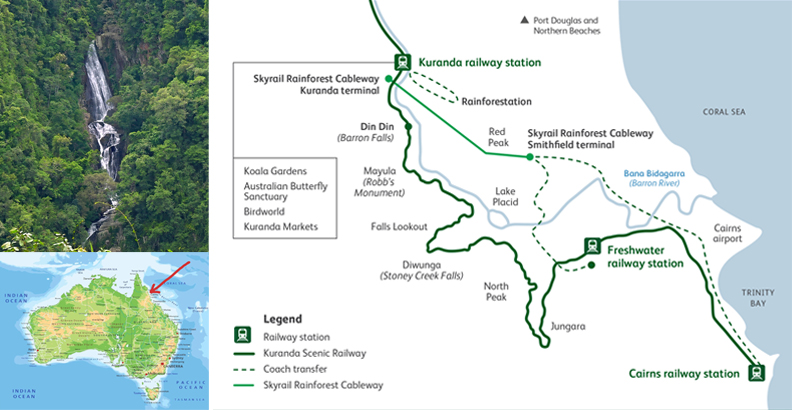
Whether as a means of getting somewhere or as the purpose of the journey itself, trains are fun and harken back to a more genteel time. So, I was pretty psyched when I learned that my family was going to be taking the Kuranda Scenic Railway—originally the Cairns-Kuranda Railway—while the ship was docked in Cairns.
Lacking a reliable supply route from the coast to where gold was being mined in the mountains (as it had been since 1873), famed bushman Christie Palmerson was tapped to rectify the situation, and in 1887, construction began on what would turn out to be one of the most daring railway undertakings ever. Roughly 1,500 men (mostly of Irish and Italian descent) laid the 20.5 miles of track that rises nearly 1,073 feet above sea level. This entailed removing 81.2 million cubic feet of earth, making 106 cuttings (i.e., paths through a hill), hand-carving 15 tunnels (totaling just under a mile in length), building 55 bridges (800.5 feet of steel bridge spans, and 6,214 feet of timber bridges), and making 98 curves.
Today, the Kuranda Scenic Railway operates trains with up to 15 heritage coaches built from Silky Oak timber. These coaches are pulled by one or two 1720-class locomotives originally built for Brisbane in 1966 and 1970, but repurposed in the late 1970s, when Brisbane’s system went electric.
Highlights of the journey by rail included the beautiful Stoney Creek Falls [see slide show] which cascaded down the cliffs that were so close to the tracks that with the windows open that I could feel the mist (though it was pretty humid, so maybe I was just sweating a lot); as well as our brief stop at the viewing platform for the Barron Falls Lookout, where we observed unobstructed views of Barron Falls that cascades 850-feet down Barron Gorge. At first, I thought the brown water was a bit gross because, well, it was brown; but I came to learn that the brown color is completely natural and results from three things: 1) Heavy tropical rains that wash soil, clay, and organic plant matter into the Barron River; 2) Storms which cause the river to rise dramatically, which erodes the riverbanks, mixing a lot of sediment into the water; and 3) Tannins released by leaves and wood that give the water a tea-colored tint.
Upon arriving in Kuranda, we meandered around, partook of a couple of the ice cream shops that seemed to pop up every 15-20 feet (I had a good Sticky Toffee cone and a fantastically whimsical Blueberry Basil cone). Then, before preparing for the ride back to the port, Jess and I decided to take a gander at the Australian Butterfly Sanctuary.
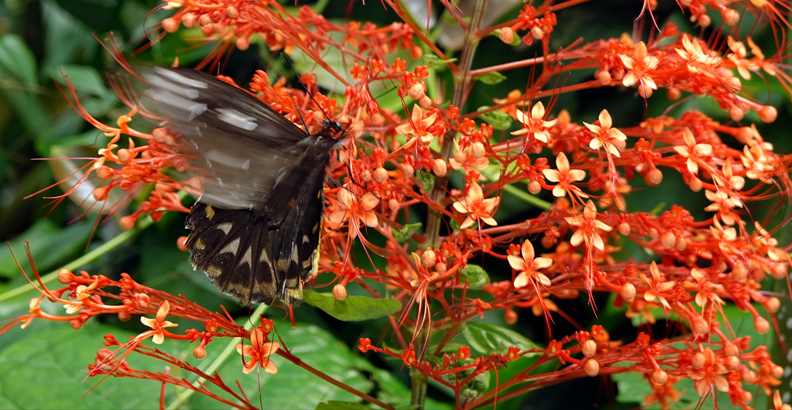
Now, I’m not good with bugs: They creep me out. But butterflies are pretty, so I figured I’d give it a shot. Once inside, after a minor freak-out that found me comparing myself to Tippi Hedren in The Birds (much to Jess’ amusement), we had a fun and educational time. I also got some fantastic photos of a female Cruiser Butterfly (Vindula arsinoe), a male Red Lacewing butterfly (Cethosia biblis), and a female Cairns Birdwing (Ornithoptera euphorion), the last of which I was able to capture on video, which I've posted above (first at full speed, then at half-speed).
All told, it was a day of lush verdancy, towering waterfalls, riding an old-school train, and beautifully colored butterflies. Full of natural splendor, Queensland, and Australia in general, rocks!
Kuranda Scenic Railway
Cairns, Queensland, Australia
Click HERE for info and tickets
Australian Butterfly Sanctuary
Kuranda, Queensland, Australia
Click HERE for info and tickets
Get into it!
#Australia
 |
 |
 |
 |
 |
 Website Powered by BannerOS. Your Business Energized!